Showing posts with label gums. Show all posts

Wednesday, April 18, 2012

Importance of Dental Care for Moms-to-be


Dental Issues In Pregnant Women Put Babies At Risk
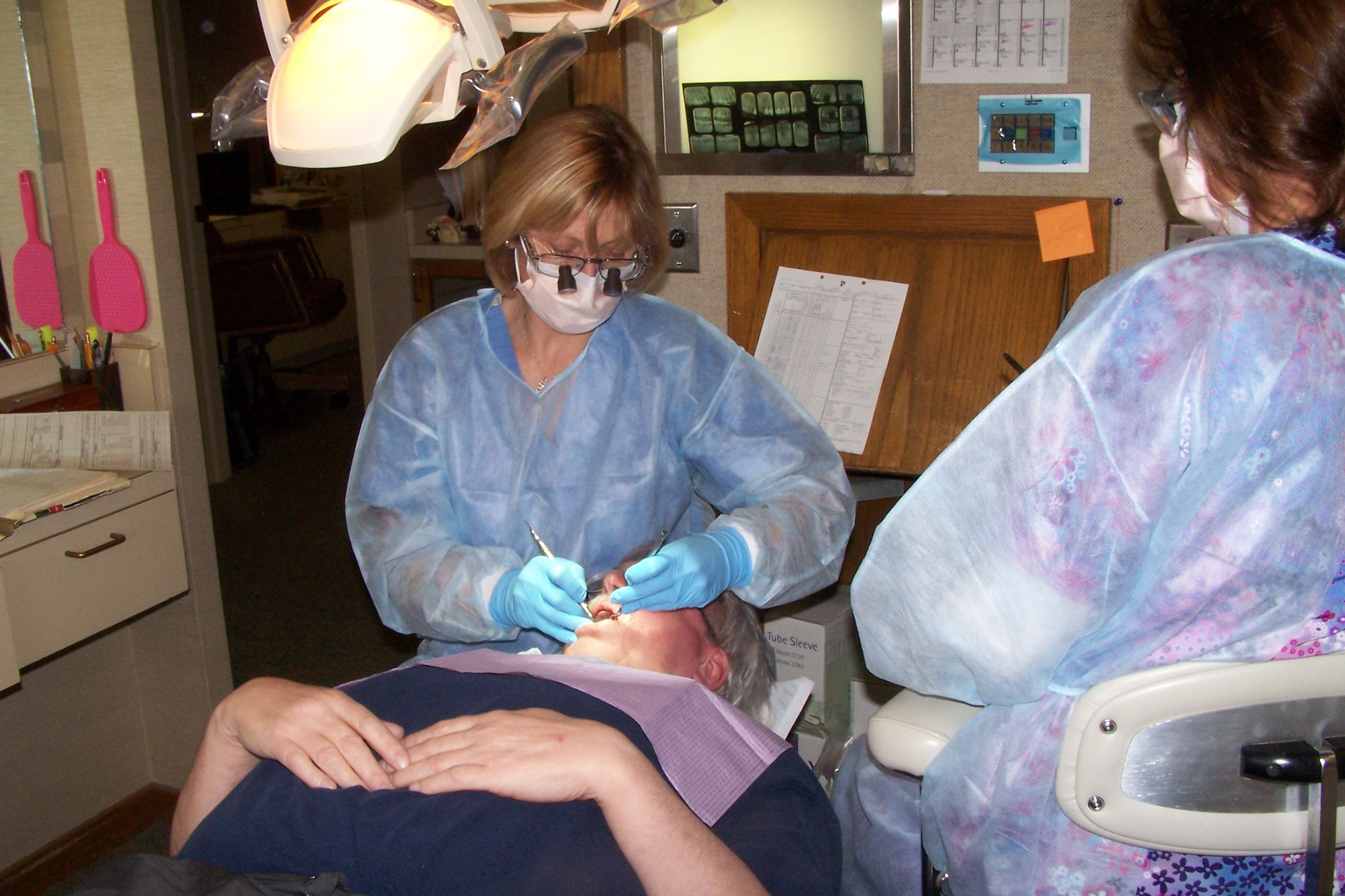
Pamela McClain, Pres. of the American Academy of Periodontology, working on a patient. Studies have determined that poor dental hygiene & gum disease lead to many other health problems, including the potential for premature and low birthweight babies.
Dentists are warning pregnant women to take care of their teeth, for the sake of their babies.
Pregnant women with cavities and gum disease have an increased risk of having premature and low-birth weight babies. They also have a good chance of passing on their bacteria and bad habits to their children.
Over the past 10-15 years, numerous studies have determined that poor dental hygiene and gum disease lead to many other health problems, said Aurora periodontist Pamela McClain, who is president of the American Academy of Periodontology. Gum disease can lead to periodontal disease, or inflammation, infection and decay of the bone and tendons around the teeth. The studies have connected periodontal disease to increased risks for cardiovascular disease, Alzheimer’s disease and even pancreatic cancer, she said.
Research has also focused on women who are expecting.
“Many, many studies have shown that high levels of [the hormone] progesterone puts pregnant women at a higher risk and more susceptible to gum diseases,” McClain said. “Pregnant women who have periodontitis are two to four times more likely to have pre-term, low birthrate babies.”
“We all have bacteria in our mouths,” she said. However, some bacteria attach to teeth and become plaque, and if that plaque is not removed, it can lead to inflammation of the gums, or gingivitis.
Untreated, the bacteria ultimately start destroying the bones in your mouth – and that is not reversible, said McClain.
McClain said the percentage of women with poor oral hygiene giving birth to babies prematurely is relatively small. However, she notes that underweight and premature babies are far more likely to have mothers with periodontal disease. 
Women with dental problems also easily pass their germs onto their babies. Jeff Kahl, a Colorado Springs pediatric dentist, says the costs of treating children ages 0-3 years old with dental problems has skyrocketed in recent years. New mothers can easily transfer their own bacteria to their babies in a myriad of ways, including kissing them, sharing utensils – anything that enables the mother to transfer saliva to the baby.
“If we can screen pregnant women who are at the highest risk, and treat them, the probability they will transmit [bacteria] to their children is much lower,” Kahl said.
A bill being considered by the Colorado legislature this year would extend dental health care to women on Medicaid who are pregnant and have just given birth. The bill, sponsored by Sen. Jeanne Nicholson (D-Black Hawk), passed the Senate Health and Human Services committee in late March, with Democrats voting in favor and Republicans opposed.
“It’s going to be a tough road,” said Kahl, who supports the effort. “The Democrats think it's the greatest thing in the world. The Republicans we talk to think it’s great but say they have a problem with the price tag.”
The bill’s estimated cost is $3.5 million in the first year and $10.3 million next year according to legislative council staff. Bills for new programs that cost money often have a hard time in the legislature.
Kahl and McClain argue the investment would be saved over the long term by preventing future expensive dental treatments for children and their mothers. They also cite the huge savings on medical costs related to premature and low-weight babies. However, Kahl concedes that saving money by providing preventative treatments can be a tough sell.
“You’re talking about kids who aren’t even born yet,” he said.
Kahl recommends that pregnant women should make sure they are as healthy as possible, and advises would-be mothers on the following:
  • As soon as possible after learning you are pregnant, get a dental check-up.
  • Take care of any cavities you may have.
  • Brush your teeth after eating.
  • Floss your teeth daily.
  • Consider using a prescription mouth rinse, with the medication Chlorhexidine, to minimize bacteria build-up in your mouth.

Sunday, November 13, 2011

Gum Disease Can Increase the Time It Takes to Become Pregnant


Science Daily -- Professor Roger Hart told the annual meeting of the European Society of Human Reproduction and Embryology that the negative effect of gum disease on conception was of the same order of magnitude as the effect of obesity.

Prof Hart, who is Professor of Reproductive Medicine at the University of Western Australia (Perth, Australia) and Medical Director of Fertility Specialists of Western Australia, stated, "Until now, there have been no published studies that investigate whether gum disease can affect a woman's chance of conceiving, so this is the first report to suggest that gum disease might be one of several factors that could be modified to improve the chances of a pregnancy."  Researchers found that women with gum disease took an average of just over seven months to become pregnant -- two months longer than the average of five months that it took women without gum disease to conceive.

Periodontal (gum) disease is a chronic, infectious and inflammatory disease of the gums and supporting tissues. It is caused by the normal bacteria that exist in everyone's mouths, which, if unchecked, can create inflammation around the tooth; the gum starts to pull away from the tooth, creating spaces (periodontal pockets) that become infected. The inflammation sets off a cascade of tissue-destructive events that can pass into the circulation. As a result, periodontal disease has been associated with heart disease, type 2 diabetes, respiratory and kidney disease, and problems in pregnancy such as miscarriage and premature birth. Around 10% of the population is believed to have severe periodontal disease. Regular brushing and flossing of teeth is the best way of preventing it.


The researchers followed a group 3737 pregnant women, who were taking part in a Western Australian study called the SMILE study, and they analysed information on pregnancy planning and pregnancy outcomes for 3416 of them.  In addition, non-Caucasian women with gum disease were more likely to take over a year to become pregnant compared to those without gum disease: their increased risk of later conception was 13.9% compared to 6.2% for women without gum disease. Caucasian women with gum disease also tended to take longer to conceive than those who were disease-free but the difference was not statistically significant (8.6% of Caucasian women with gum disease took over one year to conceive and 6.2% of women with gum disease).  "Our data suggest that the presence of periodontal disease is a modifiable risk factor, which can increase a woman's time to conception, particularly for non-Caucasians. It exerts a negative influence on fertility that is of the same order of magnitude as obesity. This study also confirms other, known negative influences upon time to conception for a woman; these include being over 35 years of age, being overweight or obese, and being a smoker. There was no correlation between the time it took to become pregnant and the socio-economic status of the woman." professor Hart said.  Information on time to conception was available for 1,956 women, and of, these, 146 women took longer than 12 months to conceive -- an indicator of impaired fertility. They were more likely to be older, non-Caucasian, to smoked and to have a body mass index over 25 kg/m2. Out of the 3416 women, 1014 (26%) had periodontal disease.

Prof Hart said that the reason why pregnancies in non-Caucasian women were more affected by gum disease could be because these women appeared to have a higher level of inflammatory response to the condition."  All women about to plan for a family should be encouraged to see their general practitioner to ensure that they are as healthy as possible before trying to conceive and so that they can be given appropriate lifestyle advice with respect to weight loss, diet and assistance with stopping smoking and drinking, plus the commencement of folic acid supplements. Additionally, it now appears that all women should also be encouraged to see their dentist to have any gum disease treated before trying to conceive. It is easily treated, usually involving no more than four dental visits." he added.

The SMILE study was one of the three largest randomised controlled trials performed in Western Australia. It showed conclusively that although treatment of periodontal disease does not prevent pre-term birth in any ethnic group, the treatment itself does not have any harmful effect on the mother or fetus during pregnancy.